At the end of last year, a scientific article in the prestigious journal Journal of Cleaner Production reporting the findings of a study that examined whether the renewal of the Icelandic trawler fleet has had an impact on greenhouse gas emissions from this vessel category. Now published is report on the project, providing a deeper dive into the methodology, implementation and results of the project. Also published is brochure highlighting various information on the purity, sustainability and nutritional value of Icelandic cod. The project was funded by the Icelandic Food Fund, and involved a number of fishing companies from across the country, along with the University of Iceland, the University of Akureyri, RISE in Sweden and Matís.
Since the turn of the century, significant renewal has taken place in the Icelandic trawler fleet, while the number of vessels in this category has decreased by almost half. It has been suggested that the new vessels are far more fuel-efficient, and that the carbon footprint of the products must therefore have decreased as a result. Data on fuel imports to fishing vessels appear to support this conclusion.
To better analyse the impact of fleet renewal on the carbon footprint of fish catches, several representatives of trawler operators joined forces with specialists from Matís, the University of Iceland, the University of Akureyri and RISE (Research Institutes of Sweden) in an assessment of the environmental impact of production systems. Data were collected from 11 trawlers over a 10-year period, and life cycle assessment methodology (Life Cycle Assessment) was applied to analyse the carbon footprint per unit of catch, and whether a comparison between older and newer vessels showed a statistically significant difference. The vessels in the sample were selected to provide a good cross-section of the Icelandic trawler fleet in terms of size, age, catch composition and location around the country. The sample included four new vessels purchased to replace older ones, allowing a comparison between older and newer vessels within the same company, with the same fishing quotas and even the same crew.
Efficiency improvements in the fishing fleet are decisive when it comes to reducing the carbon footprint
The results of the analysis revealed that it is difficult to conclude that fleet renewal alone has had an impact on the carbon footprint per unit of catch. Three of the four new vessels examined did not show a significantly lower carbon footprint than the older vessels they replaced. The fourth vessel, however, replaced two older vessels, and in that case a significant reduction was observed. The most likely explanation, however, is that since the fishing quotas of two vessels were consolidated onto one new vessel, it is quota status and operational patterns that have a dominant influence, rather than the age of the vessels. These findings are broadly consistent with previous studies in this country, which have shown that the condition of fish stocks, fishing quotas and operational patterns are by far the most important factors when it comes to greenhouse gas emissions per unit of catch. Thus, the consolidation of fishing quotas and reduction in the number of vessels have had a decisive impact on reducing the carbon footprint, rather than fleet renewal. It should be borne in mind, however, that year-on-year comparisons can be difficult, as fish abundance and catch rates can vary considerably between years.
A more comprehensive analysis of the carbon footprint of trawler catches than has previously been seen in Iceland
The results of the life cycle assessment also provided information on the average carbon footprint per unit of catch for the vessels in the sample. This is highly valuable information, as such a comprehensive analysis of the carbon footprint of trawler catches has not previously been carried out in Iceland. Earlier data covered only individual trawlers over much shorter periods. The results show that the carbon footprint of landed cod catches is 0.7 kg CO2 equivalent/kg catch, 0.8 kg when the carbon footprint is allocated to the portion of the catch that becomes food, and 4.5 kg when allocated per protein unit. Similar results were obtained for haddock and saithe, while the carbon footprint of redfish is considerably higher, as the fishing itself is more energy-intensive and the utilisation for human consumption is much lower. These findings are broadly consistent with comparable studies carried out in recent years in the countries we most readily benchmark ourselves against. Recent analyses of the carbon footprint of Norwegian trawler catches show, for example, that it is broadly comparable to that of Iceland when measured in CO₂ equivalents per catch landed from the sea. However, for each kilogram of landed catch, the Norwegian trawler fleet burns 0.35 litres of fuel compared to 0.26 litres for the Icelandic fleet, with the difference likely attributable to the high proportion of the Norwegian trawler catch that is frozen at sea.
If the carbon footprint of the trawlers in the study sample is compared with the results of similar research published in 2014which also included an analysis of the carbon footprint of longline vessels, it can be seen that the footprint of longline vessels is approximately half that of trawlers. However, that study included only two larger longline vessels and two small boats in the sample, and the data covered only a single year. There would therefore be every reason to repeat that analysis with data as comprehensive as those collected for the trawler analysis.
Icelandic fish among the lowest carbon footprint foods in comparison with other foodstuffs
When the aforementioned carbon footprints of trawler catches are compared with other foodstuffs, it is clear that Icelandic trawler-caught fish is among the protein sources in the world with the smallest environmental footprint. Looking at CO₂ equivalents per kilogram of food protein (kg CO2 eq/kg edible protein) chicken, for example, has a carbon footprint per protein unit more than 12 times greater than that of cod, pork has a footprint 17 times greater, and beef 80 times greater. It should be noted, however, that these are global averages.
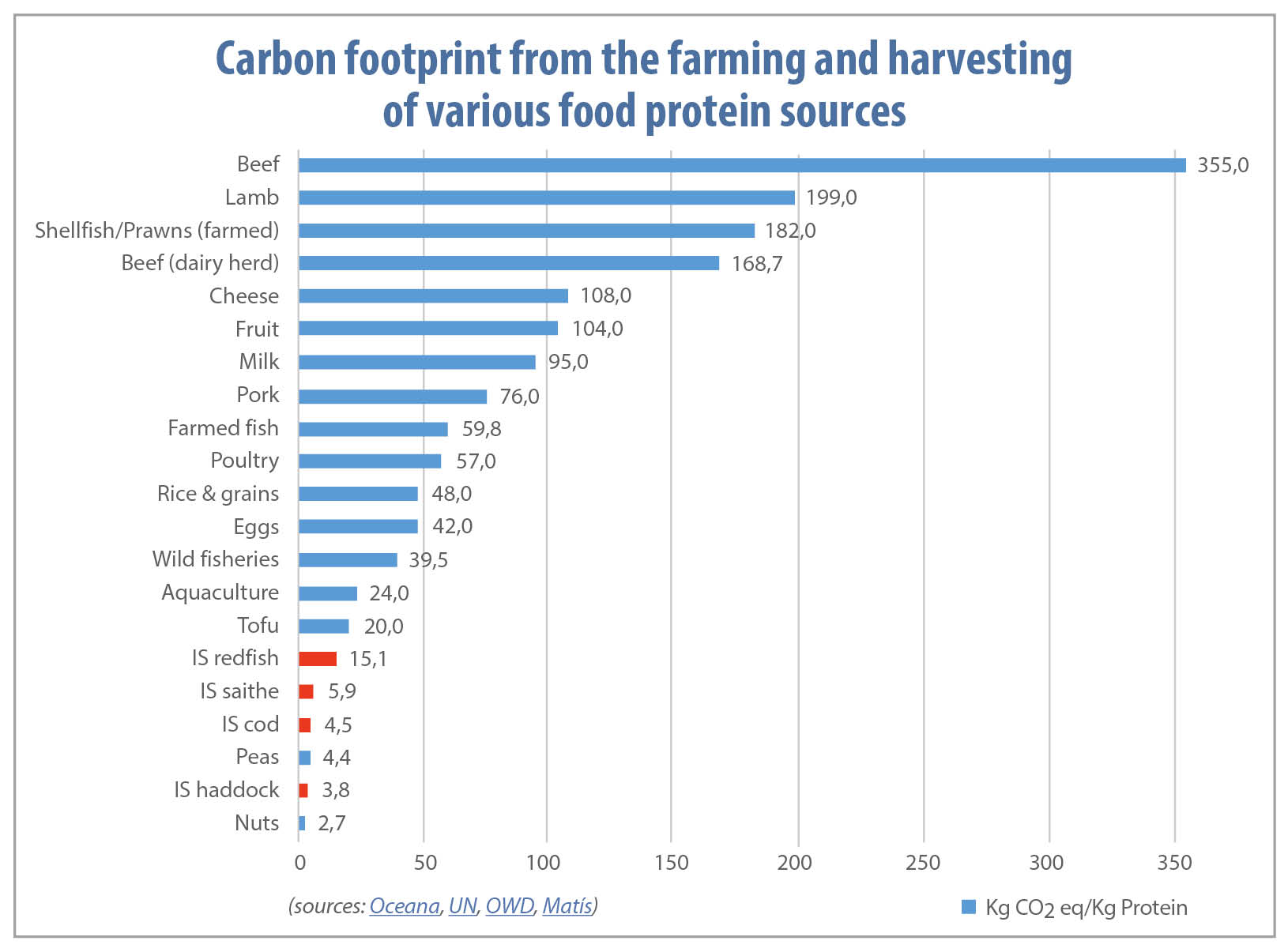
It should be borne in mind that the life cycle assessment covered only the fishing stage of the value chain, and that factors previously shown to have a negligible impact on the carbon footprint of trawl fishing were not included in the calculations. The impact of trawl fishing on the seabed was also not taken into account; in recent years, evidence has emerged suggesting that trawling releases large quantities of CO2 that is bound in seabed sediments. However, the scientific community has not yet reached consensus on what those impacts actually are. The assessment was carried out in accordance with international standard ISO 14044, and the results are therefore fully comparable with other studies that have followed the same standards.
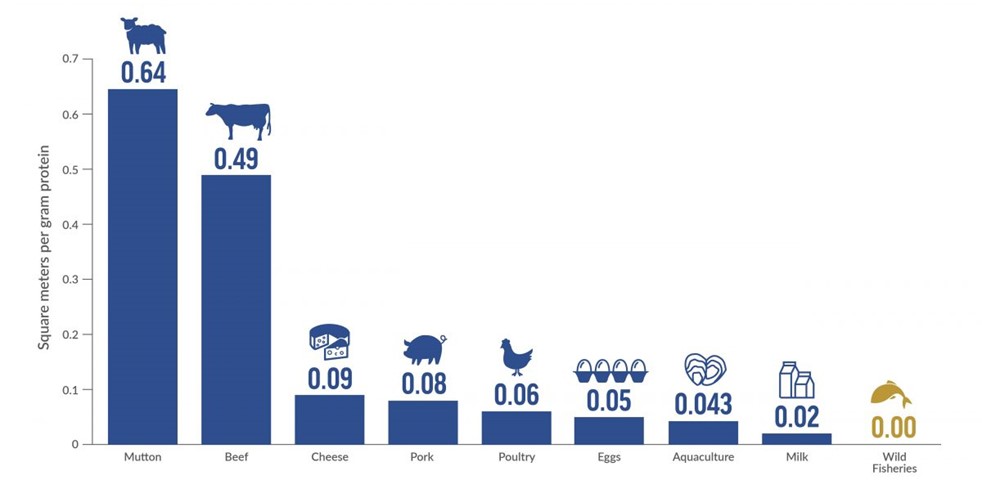
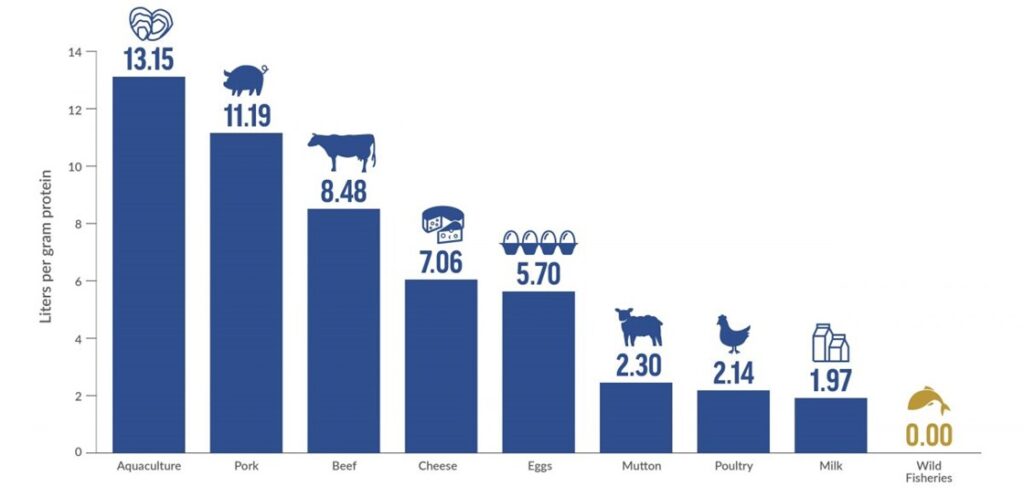
Finally, it is worth noting that the production of most foodstuffs requires large amounts of land and freshwater, neither of which is needed in the case of wild-caught seafood.
Further information is available at project website