
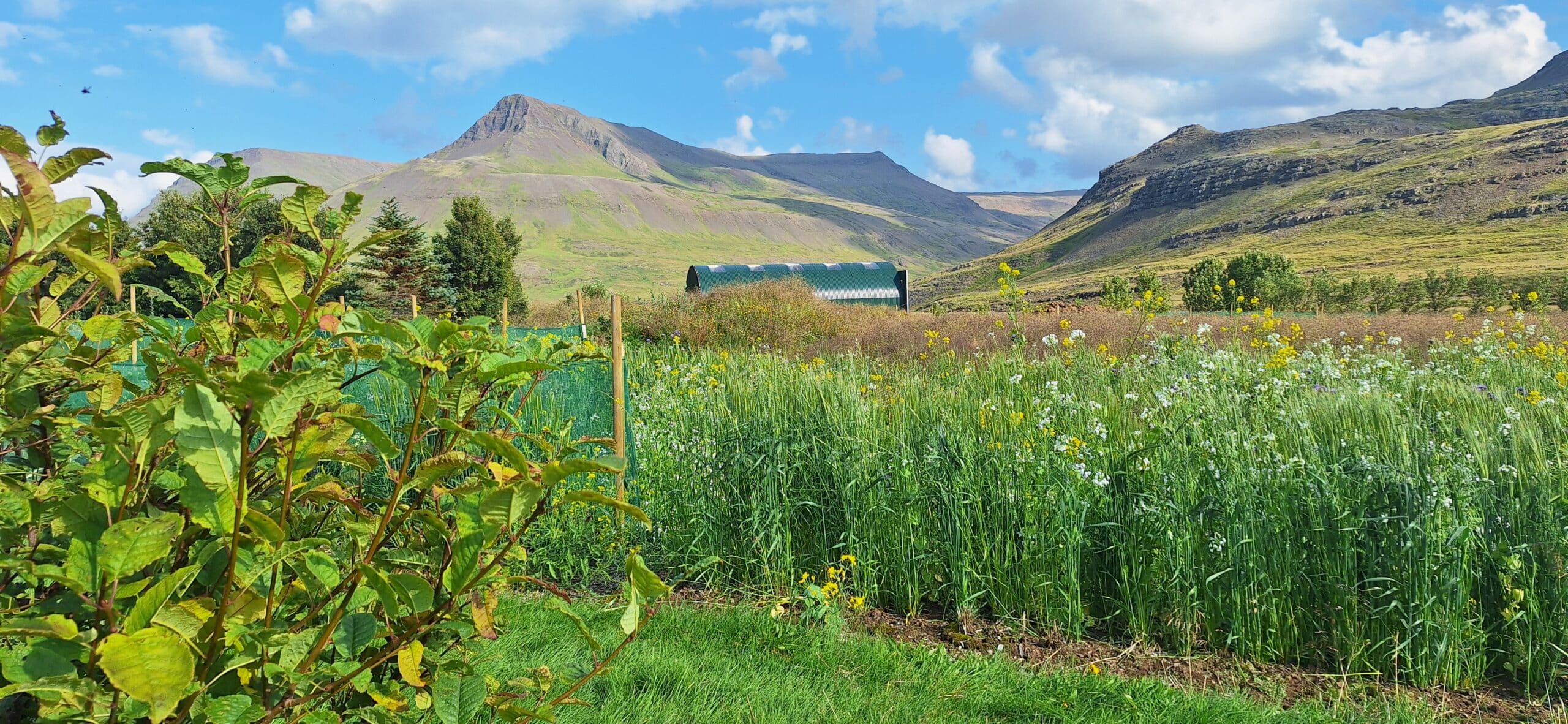
The couple Haraldur Guðjónsson and Þórunn Ólafsdóttir grow garlic at Neðri Brekka in Saurbær in Dalir. Matís works with them on the Dalahvítlaukur project, with product development taking place entirely at Matís's facilities at Vínlandsleið. But how did this adventure begin? The couple from Dölum tell the story here.
The idea for the garlic salt came when we saw how much leftover garlic cloves there were. How could we use this quantity – surely something could be made from it. When the garlic bulb is separated, raw material is left over, as only the largest cloves are taken for seed. Then the question arose of what to do with the remainder, which is also valuable. Really, it's resource recovery.
Initially the plan was just to grow garlic and do it as organically as we can. We don't use any synthetic fertiliser or other chemical substances, such as insecticides, fungicides and herbicides. We use the most diverse cover crop possible from annual plants alone, from most families. We sow barley, wheat, rye, Italian ryegrass, carrots, lettuce, red clover, phacelia, mustard flowers, kale, radishes, peas, spinach, turnips and more. We don't turn or plough the soil, because by doing so we're tearing up the home of microorganisms, earthworms, mycorrhizal fungi and other organic matter. With this method, by disturbing the soil as little as possible and using cover crops, we're building up the soil and its organic mass and the microbial life that lives there. You could call it underground livestock.
Organic soil with regenerative agriculture
The cover crop dies over winter and forms a blanket – or cover over the soil, protecting the topsoil from weather, wind and temperature changes. It also serves as food for microorganisms. Over time, organic soil builds up. It has emerged that this doesn't take long on average. Results appear quickly, even within 2 to 4 years. This is part of what is called regenerative agriculture.
The fertiliser given to the garlic is seaweed meal, seaweed, horse manure, cow manure and other organic fertiliser.
Through this cultivation we grow healthier garlic that is flavourful and can be stored for many months.
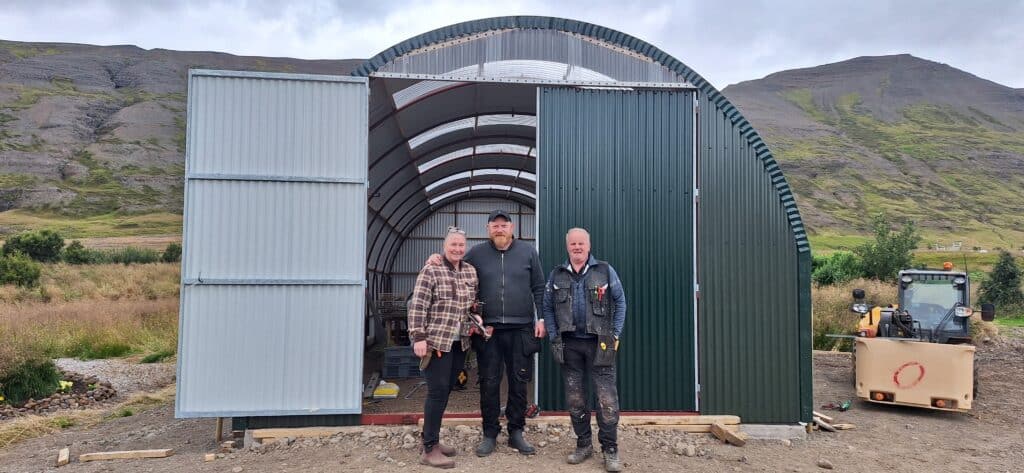
When word spread that we were growing garlic, we were contacted by the company Bananar ehf. They wanted to make an agreement with us to purchase the bulk of the marketable harvest of whole garlic for sale in their stores. The company Svarthamar Vestur ehf was established around the garlic business and an agreement was made with Bananar regarding the sale of whole garlic.
How Is Success Measured in the Cultivation?
The project establishes three main indicators to assess progress and status. These indicators primarily evaluate where the project stands at any given time and what the ultimate objective of each indicator and the project as a whole is.
One of the main objectives of the project is to enhance and improve the ecosystem and soil cultivation conditions based on the methods the project employs in production. The indicator that will provide the clearest picture of success will be production yield per cultivation area. The cultivation area is currently about 2 hectares in size, and we expect that area to yield several tonnes of garlic per year after 3-4 years.
Annar mælikvaði er aukin sustainability í framleiðslu. Til að byrja þessa ræktun þarf að flytja inn hvítlauk erlendis frá, þar sem ekki er til íslensk framleiða á hvítlauk í dag.
The final indicator for the project would be that its productivity and profitability reach a point where all costs related to cultivation and operation, such as purchasing organic fertiliser (compost, composted material, seaweed, chicken and worm manure), bed maintenance (wood chips and seaweed meal), become sustainable – i.e. that the profit from the sale of whole garlic and by-products covers production and cultivation costs.
Another thing the project does is regularly measure the pH value and moisture content of the soil, to monitor the organic conditions for cultivation and ensure that the values are normal. The development and formation of organic mass in the soil is also monitored.
We draw on the knowledge and experience of those who practice regenerative agriculture and are always looking for garlic seed and other seeds that suit the area.
Older Cultivation Areas Yield Richer Soil and Larger Garlic
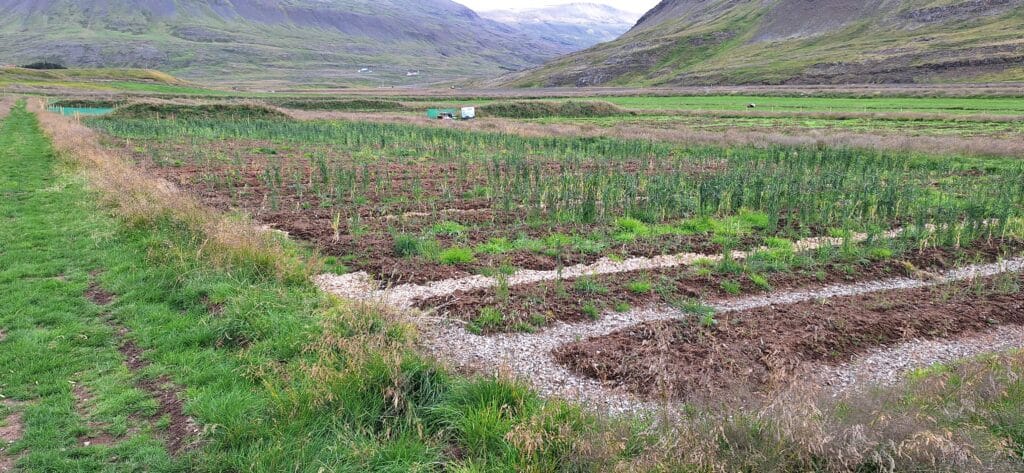
These are two old fields just outside our property, which the project began using for this cultivation in 2024 as part of scaling up production. It takes time to increase the organic mass in soil where synthetic fertiliser has been applied for many years, as mentioned above. The oldest beds, which are on our land, are in their fourth year, while the new area is in its second year. There is already a visible difference in the soil between the oldest cultivation areas and the newer ones, and the garlic was generally also larger in the older soil.
Thus the project is on the right track towards achieving the goals of increasing organic matter and biological diversity in the soil.
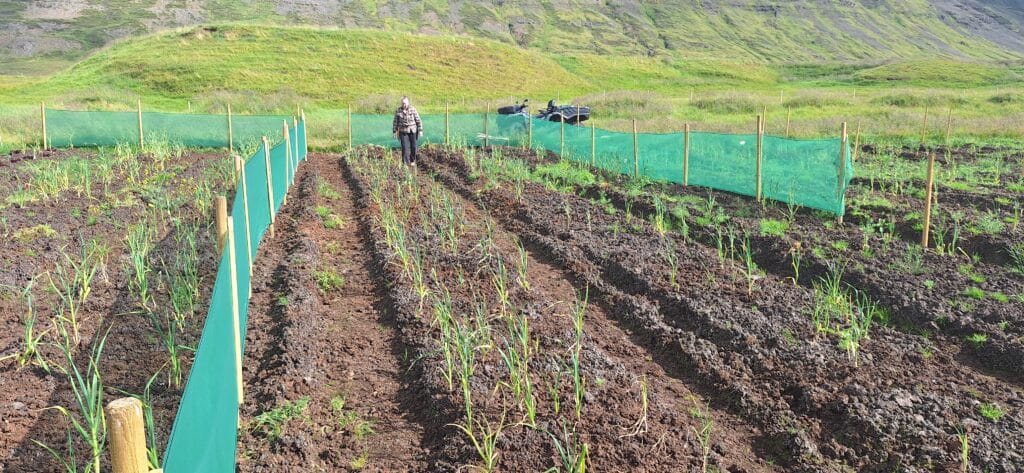
The Cultivation Yields Increased Wildlife and a Valuable Learning Process
We have noticed an increase in wildlife. More birds and even more bird species, more bees, more earthworms and just more life of various kinds. There are even new plant species emerging that we haven't seen before in the area.
Last year, in 2024, we used a special garlic planter, which we received a grant from the West Iceland Development Fund to purchase and import. It worked poorly last year due to wetness and mud, and therefore the machine failed to plant the garlic deep enough.
It emerged that the garlic was upside down, lying on its side, and when the garlic doesn't face the right way, extra energy is required for the growing stem to find its way up and turn correctly. This therefore reduces the growth of the garlic, so it doesn't become as large. Our experience with this machine is that it's better to hand-plant the garlic as was done in several places last year, because there the garlic emergence was 95% and it was a good size, resulting in better results. The garlic needs to go down about 10-12 cm with the root side facing downwards. That way it roots correctly and quickly and grows properly. This is the lesson we have learned.
It Is Important That the Soil pH Is Not Too Acidic
Last year we dug many test holes in both fields that we took on lease and measured the pH acidity level there. Clearly not with a good enough meter, because it said the acidity level was above 6 in all locations. The garlic got off to a good start on both the upper and lower fields, but then it became apparent that it was somewhat weak in the lower area. The condition didn't improve, despite fertiliser application. The soil was then measured again, this time with a better and more accurate meter. It then emerged that the entire lower area was far too acidic, down to as low as 5.3. Garlic doesn't thrive in such acidic soil. It needs a pH value between 6 and 7. In the end, all the garlic in the lower area died due to overly acidic soil. We responded immediately by sowing many cover crop plants that should raise the pH value slightly. Next spring we will mix the soil there with dolomite lime and shell sand to bring the acidity level above the threshold that is acceptable for garlic. That area needs cover cropping next spring and garlic planting there next autumn.
Always learning something!
What Does the Future Look Like?
We see a big difference in all crops and vegetables from last year, and the garlic is larger than last year, though it can be done better. We are very optimistic about the future and realise that this is ongoing work and monitoring that lies ahead.
The project received a grant from the Icelandic Food Fund to develop more products from the garlic. Garlic salt called Skjöldur had already been developed and was in production. A quality manual for its production was created with the help of Óli Þór Hilmarsson at Matís, and the project received an operating licence from the Food and Veterinary Authority (MAST). Development then took place on garlic salt with thyme called Auður, garlic confit (slow-cooked garlic cloves in olive oil) called Bersir, and garlic oil called Hyrna.
Auður and Bersir sold out quickly, but some Skjöldur is still available, as more of it was produced. There wasn't enough garlic to start production of the garlic oil Hyrna this spring, but it will be produced this autumn and will come to market before Christmas. The garlic oil underwent sensory evaluation at Matís and performed well, and we are optimistic about its sales.
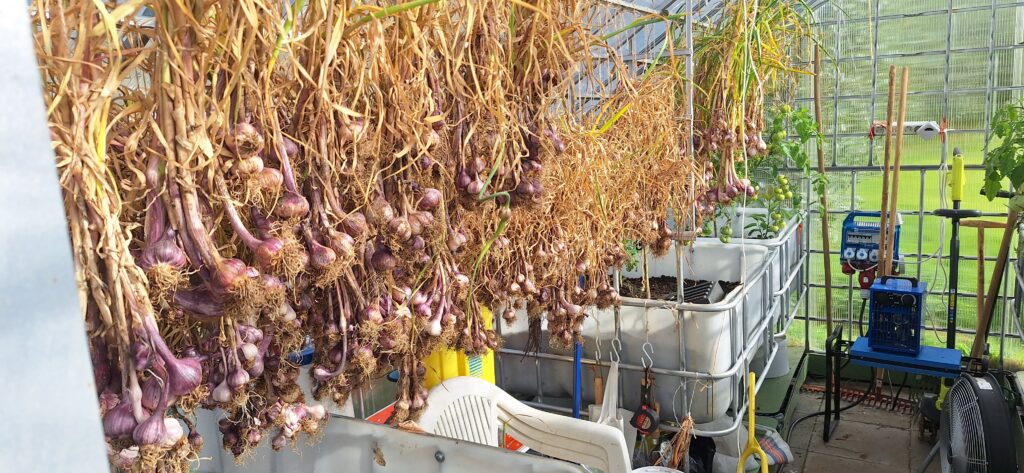
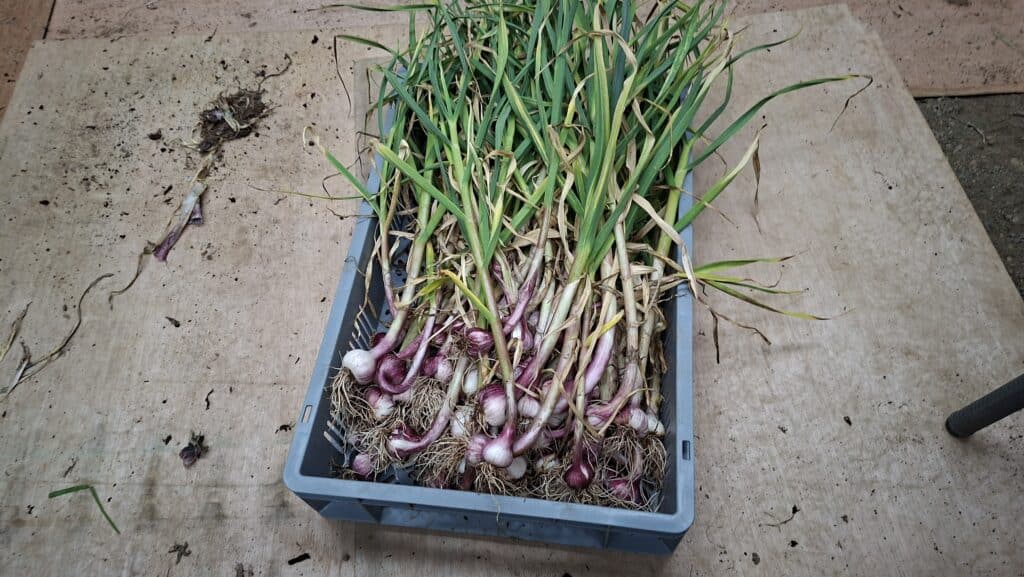
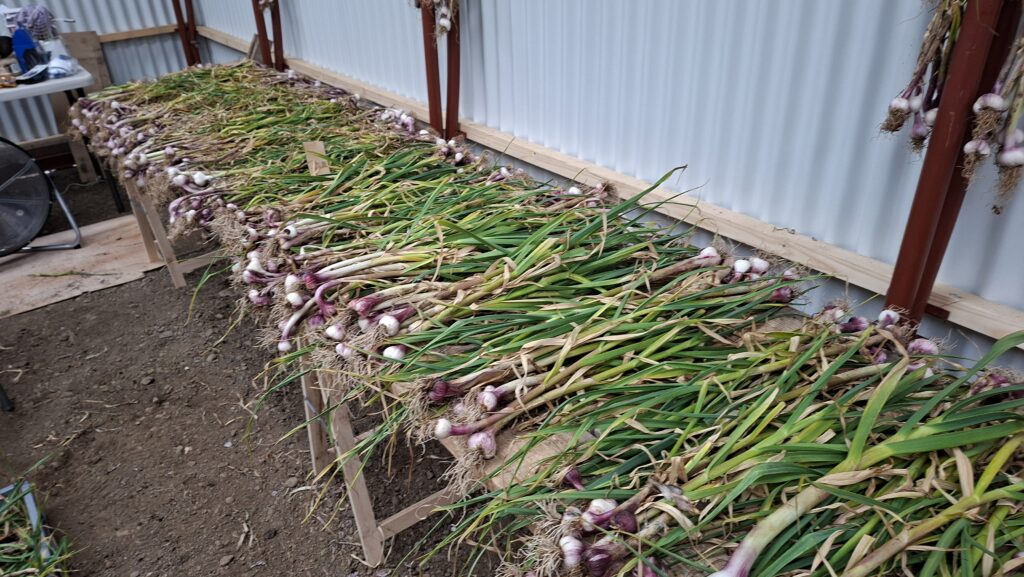
The next step is to process the garlic after it has been harvested. It has been hung up to dry, which takes about four weeks. This allows it to draw in all the nutrition from the leaves and stem. This way it becomes more flavourful and keeps longer.
The garlic is then trimmed, cleaned, sorted and sold. In mid-September, garlic seed arrives from France, as last year, and it will be hand-planted as quickly as possible.
When planting is complete, we head to town to produce the above-mentioned by-products from those garlic cloves that didn't become seed or go to sale, using this surplus garlic. This will all be processed in Matís's test kitchen at Vínlandsleið.
Our main collaborators at Matís have been Óli Þór Hilmarsson and Ólafur Reykdal. Þóra Valsdóttir and Aðalheiður Ólafsdóttir have also been involved in this project. Funding sources are: Icelandic Food Fund - Afurð, Icelandic Food Fund - Fjársjóður DalaAuður, and West Iceland Development Fund.