
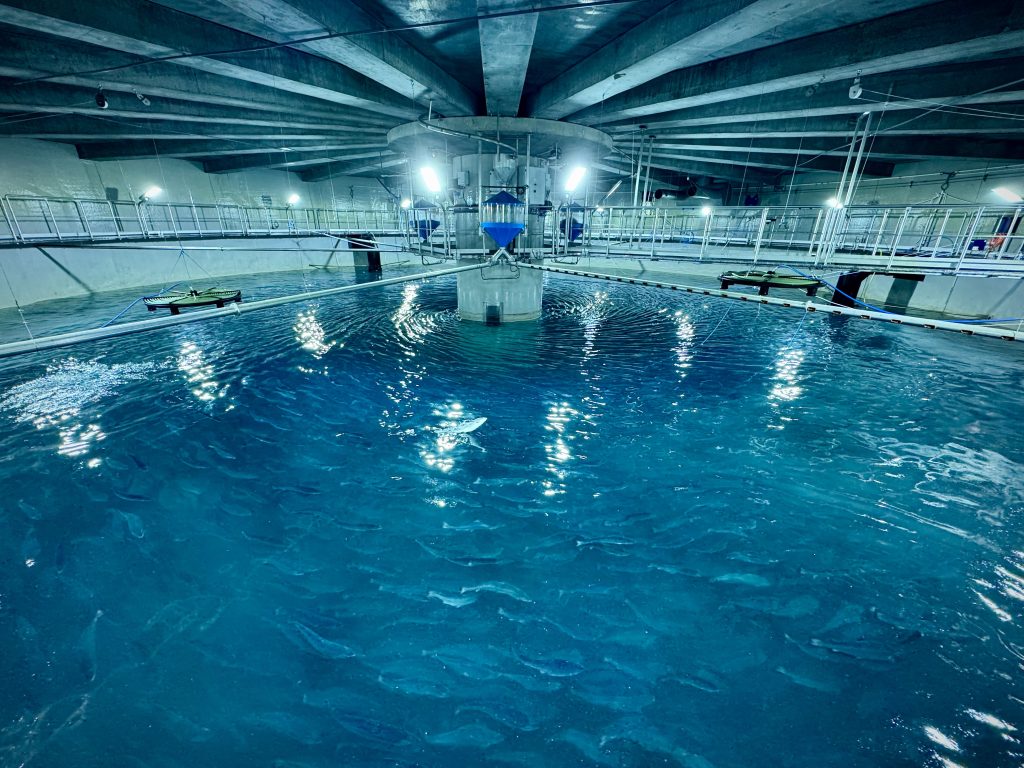
With the significant expansion of land-based aquaculture, salmon manure — i.e. salmon faeces and uneaten feed — will accumulate and must be utilized responsibly. If the plans of land-based aquaculture companies come to fruition, over 100,000 tonnes of dewatered manure, with approximately 25% dry matter content, are expected to be generated annually. In the OCCAM project, Matís is collaborating with Samherji Aquaculture to investigate the production of biochar through pyrolysis. In this process, dewatered manure is heated to high temperatures (500–700°C) under anaerobic conditions, producing biochar, oil and gas. This biochar has specific properties and can be used as a soil amendment or for fertilizer products. It is important for land-based aquaculture companies to find viable solutions to these issues alongside the rapid expansion currently taking place.
It is vitally important that information regarding the potential uses of the manure is made visible and that industry stakeholders are kept informed of the latest research and trial results. The workshop "Skítur skeður" ("Shit Happens"), addressing the challenges surrounding aquaculture manure and related issues, was therefore a welcome opportunity to bring together stakeholders approaching these matters from different perspectives. The workshop was held at Matís, Vínlandsleið 12, on Monday 8 June 2026.
The objective of the OCCAM Horizon project is to develop, test, demonstrate, evaluate and ultimately implement solutions in the area of mitigation and adaptation measures in response to the impacts of climate change on the aquaculture industry in Europe. The group of participants consists of 22 companies, government representatives, universities and other research institutions. The solutions will be developed and implemented across 9 sites throughout Europe.
Photo: Laxey