Reports

Analysis of the amount of organic fertilizers in Iceland and opportunities for increased utilization

Published:

15/04/2022

Authors:

Jónas Baldursson, Eva Margrét Jónudóttir, Magnús H. Jóhannsson

Supported by:

Rannís 2020 target plan - Social challenges

Contact

Jónas Baldursson

Project Manager

jonasb@matis.is

By far the largest part of field cultivation is carried on with the use of artificial fertilizers. The main nutrients considered in fertilizers are nitrogen (N), phosphorus (P), potassium (K), calcium (Ca) and sulfur (S) along with numerous trace elements. Organic waste contains these same nutrients but is not the best fertilizer available in terms of nutrient concentration or cost of application. In view of the fact that the price of synthetic fertilizers has doubled between years, that it is a matter of limited resources and its unfriendly production, organic waste and by-products of processing have become even more important resources that are worth using more and more.

The research and innovation project Sustainable fertilizer production - a comprehensive approach to the circular economy was funded by Ranni's Target Program at the beginning of 2021, where the collaborative group explores ways to use local organic resources, by-products from various types of production and processes to produce sustainable fertilizers for Icelandic agriculture and land reclamation . This report is one part of the project where an assessment was made of the organic waste generated in Iceland, both in terms of quantity and nutrient composition.

The objectives of this report were as follows:
– To identify and calculate the amount of organic waste that is generated in Iceland and could be used in the production of fertiliser. calculate the amount of organic waste that is generated in Iceland and could be used in the production of fertilizer.
- To calculate the amount of nutrients (NPK) in organic waste according to the measurements carried out in the project together with national and foreign sources where information was missing.
- To make proposals and identify where the main opportunities lie in the increased use of organic waste for fertilizer production in Iceland.

The amount of organic waste from animals was calculated based on the number of animals, their feed needs and feed utilization. When calculating the amount of other organic substances, the accounts of the Environment Agency were used. The nutritional content of organic raw materials was found out either through chemical measurements, literature searches, or both.

The results of this project shed light on opportunities for increased utilization of organic waste for fertilizer and the existing facilities. Results indicate that the total amount of NPK nutrients in organic waste generated in Iceland is similar to that in imported synthetic fertilizers, but the amount of nitrogen is considerably lower. In terms of opportunities for increased utilization, fish farm sludge, slaughterhouse waste and poultry droppings should be mentioned most prominently. Organic waste is usually rich in water and the concentration of nutrients is low. Therefore, a larger amount of waste with associated transport costs or further processing is needed to obtain a similar effect as with imported synthetic fertilizers.

View report

Matís services reduced today due to a women's strike

Matís will accommodate staff due to the women's strike, but will at the same time ensure that the main services will be kept running today.

Like many companies and organizations, Matís will not deduct the wages of those who participate in the women's strike.

What are the impacts of benthic disturbance from fisheries?

In 2021 Sale et al. published in NATURE a paper claiming that global bottom trawling is responsible for as much carbon release as air travel. The paper received great attention and has been debated heavily since then. In 2023 Hiddink et al. published also in NATURE a paper that refutes the assertion in the paper of Sale et al. The issue remains debated, and it is clear that more research is needed.

At a conference on Environmental impacts and energy transition in the Nordic seafood sector, which will be held in Reykjavík on September 13th, Dr. Ole Ritzau Eigaard from DTU will try to get to the bottom of these claims. What are the impacts of benthic disturbance from fisheries?

The conference attendance is free of charge, but registration is required at the conference webpage.


What is the effect of bottom trawling on the seabed?

The year 2021 appears in NATURE article where it was claimed that bottom trawling in the world was responsible for similar carbon emissions as the entire aviation sector in the world. The article attracted a lot of attention at the time and, among other things, was regularly quoted in the debate about coastal fishing and environmentally friendly small boat fishing. In 2023, NATURE published so another article where the results of the previous article were criticized.

The subject is controversial and it is clear that further research is needed, but conference on environmental impact and energy exchange in the Nordic fishing industry, which will be held in Harpa on September 13, Dr. Ole Ritzau Eigaard from DTU tries to get to the bottom of these claims. What is the effect of bottom trawling on the seabed?

Admission to the conference is free, but registration is required website of the conference.

News

Guide to the use of organic materials for fertilization in agriculture and land reclamation

The Ministry of Food is currently working on a road map for the use of organic materials for fertilizer in agriculture and land reclamation. The roadmap takes into account the government's climate policy and circular economy policy and is intended to show the way to how the set goal of sustainable use of organic materials for fertilizer will be achieved step by step in 2040 or earlier.

The project consists, among other things, in presenting a straightforward and credible plan that includes, among other things: assessment of the current situation, analysis of opportunities and their prioritization, as well as the presentation of scenarios. The Ministry of Food is responsible for the preparation of the roadmap, but has hired the Efla engineering firm to help with the work, in addition to the fact that the Ministry's institutions and stakeholders sit on the steering committee, i.e. Matís, RML, Landgroðslan and MAST.

Fourth of October a working meeting was held in the project where 35 business partners from various industries had the opportunity to get to know the preparation of the road map and bring input to the work. The meeting was held in Matís' house, and good discussions took place there, which will undoubtedly be useful in the preparation of the road map, which is expected to be published before the end of the year.

grid test

Tess

http://www1.matis.is/ISGEM/search1.aspx

Do you need product development facilities?

Dissemination

News

Recordings from MNÍ's food day

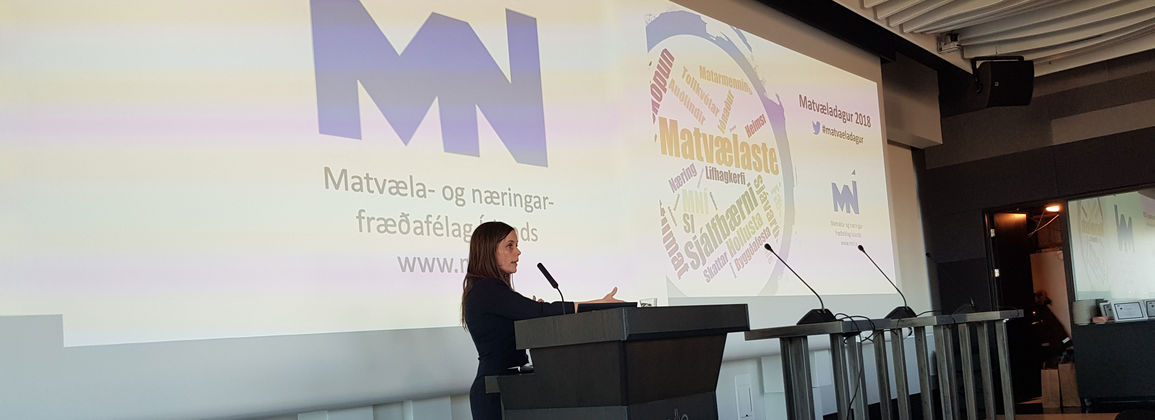
Food Day of the Icelandic Food and Nutrition Association took place on 25 October. The agenda was to discuss food policy for Iceland from as many angles as possible, and numerous speakers with their perspectives and organizations came to the meeting. 

A lively discussion ensued, as it seems to everyone when it comes to formulating food policy for Iceland. More than 100 people attended the day. 

Food Day was welcomed for the work that lies ahead in setting a food policy for Iceland, but the Minister of Fisheries and Agriculture put together a group that will put together this policy and it is expected that this work will be completed by the end of 2019. 

Fjöreggið was also handed over, but the prize is awarded for a praiseworthy initiative in the field of food and nutrition. This time it was Rjómabúið in Erpsstaðir that received Fjöreggið. 

Recordings and slides (where applicable)

Lecturer and topicRecording starts and ends approx.Slides (pptx)
Moderator | Hrönn Ólína Jörundsdóttir, Matís.13:00 - 13:02 
Sentence | The Prime Minister, Katrín Jakobsdóttir.13:02 - 13:15 
Delivery of Fjöreggsinn | Guðrún Hafsteinsdóttir, Confederation of Icelandic Industries.13:15 - 13:30 
Arnljótur Bjarki Bergsson, Matís.13:30 - 13:40Food policy in the context of the bioeconomy; West Nordic Bioeconomy Panel.
Kristín Vala Ragnarsdóttir, University of Iceland.13:40 - 13:51Can we pursue food policy without sustainability thinking?
Jóna Björg Hlöðversdóttir, Association of Young Farmers.13:51 - 14:02 Who is food policy for?
Magnús Óli Ólafsson, Innnes.14:02 - 14:12 Do importers' views fit into Iceland's food policy?
Kristján Þórarinsson, Association of companies in the fisheries sector.14:12 - 14:22 Food policy: common elements.
Ari Edwald, Mjólkursamsalan.14:22 - 14:33 Incentives for increased raw material utilization.
Coffee.14:33 - 15:00 
Sæmundur Sveinsson, LHBÍ.15:00 - 15:10 Sustainable agriculture? The World Goals? What can the Agricultural University of Iceland do?
Axel Helgason, National Association of Small Boat Owners.15:10 - 15:20 Consumer choices and their responsibility towards the environment.
Bryndís Eva Birgisdóttir, Laboratory of Nutrition.15:20 - 15:31 Food policy - A policy for food enjoyment and improved public health.
Harpa Júlíusdóttir, United Nations in Iceland.15:31 - 15:42 United Nations Global Goals and Sustainable Development.
Panel discussion.15:42 - 16:12 
Hrönn Ólína Jörundsdóttir, Matís.16:12 - 16:24 

News

Doctoral defense - the effect of fat development in feed on farmed fish

On Thursday 15 June, Godfrey Kawooya Kubiriza will defend her doctoral dissertation at the Faculty of Life and Environmental Sciences, University of Iceland. The thesis is entitled: The effects of dietary lipid oxidation on farmed fish.

When does this event start: June 15, 2017 - 1:00 p.m.
Event location: Main building
Further location: Celebration hall

Opponents are dr. Anders Kiessling, Professor at the Swedish University of Agricultural Sciences, Department of Animal Nutrition and Husbandry, Sweden, and Þórarinn Sveinsson, Professor at the University of Iceland School of Medicine.

Supervisors are Helgi Thorarensen, professor at Hólar University, and Sigurður Snorrason, professor at the Faculty of Life and Environmental Sciences. Other members of the doctoral committee are Ólafur Sigurgeirsson, lecturer at Hólar University, Anne M. Akol, Makerere University in Uganda, Jón Árnason, specialist at Matís, and Tumi Tómasson, director of the United Nations University's Fisheries School.

Dr. Anna Dóra Sæþórsdóttir, dean and professor at the Faculty of Life and Environmental Sciences at the University of Iceland, will lead the defense, which will take place in the Celebration Hall of the main building, starting at 13:00.

Summary of study

Although conditions for aquaculture in Uganda and East Africa are good, aquaculture production in the region is still relatively low. The main obstacle to the further growth of aquaculture is the lack of cost-effective feed, which is produced from raw materials from the area. In the doctoral project, experiments were performed that address this problem: 1) By defining the ideal setup of growth experiments (the most suitable number of fish and repetitions of treatments) and the best statistical methods for analyzing the data. 2) The effect of development on fish oil in fish feed was investigated. The results indicate that evolution does not affect the growth of Nile borer (Oreochromis niloticus) in ponds rich in algae, rich in antioxidants. 3) The antioxidant activity of ethoxiquin (EQ), which is widely used in fish feed, was compared with new antioxidants: rosemary oil (RM; Rosmarinus officinalis) and seaweed (BH; Fucus vesiculosus). The results suggest that RM can prevent the development of fish oil as well as EQ as well as encourage better fish growth than EQ or BÞ. (4) New raw materials for fish feed produced in Uganda were tested. The results indicate that it is economical to use the shrimp Caradina nilotica, which is a by-catch from fishing in Lake Victoria, in feed, thus replacing fishmeal from Rastrineobola argentea, which can be used directly for human consumption. The results of these experiments are an important contribution to the further development of aquaculture in Uganda and East Africa, in particular the production of feed for farmed fish.

About the doctoral dissertation

Godfrey Kawooya Kubiriza was born on August 7, 1979 in Uganda. His parents are Yekosofati Kawooya Kayizzi and Khezia Nakiryowa from Kikwayi in Uganda's Mukono province. Godfrey is the ninth of twelve siblings. He is an assistant professor at Makerere University in Kampala.

Godfrey received his primary and secondary education at Bishop's Central Primary School, Namakwa Senior Secondary School and Bishop's Senior School in Mukono. In 2004, he completed his B.Sc. degree in Fisheries and Aquaculture from Makerere University. He graduated with honors in 2009 from the University of Malawi, Bunda College, which was supported by the Icelandic International Development Agency. From 2009 to 2010, Godfrey was a grant recipient of the United Nations Fisheries Academy and specialized in aquaculture at Hólar University. His supervisors in Iceland were Helgi Thorarensen and Ólafur Sigurgeirsson at Hólar University and Albert K. Imsland at Akvaplan Niva. Godfrey's final project on Hólar dealt with the organization of experiments and statistical processing in aquaculture research.

Godfrey began his doctoral studies at the University of Iceland in 2011 with a scholarship from the Fisheries Academy. The final project at Hólar was part of the doctoral project. Godfrey's doctoral dissertation deals with a variety of topics, in particular the effects of fat degradation in feed on farmed fish and ways to avoid evolution, as well as statistical processing in growth experiments. Godfrey's research is an important contribution to the further development of aquaculture in Uganda and East Africa.

EN