

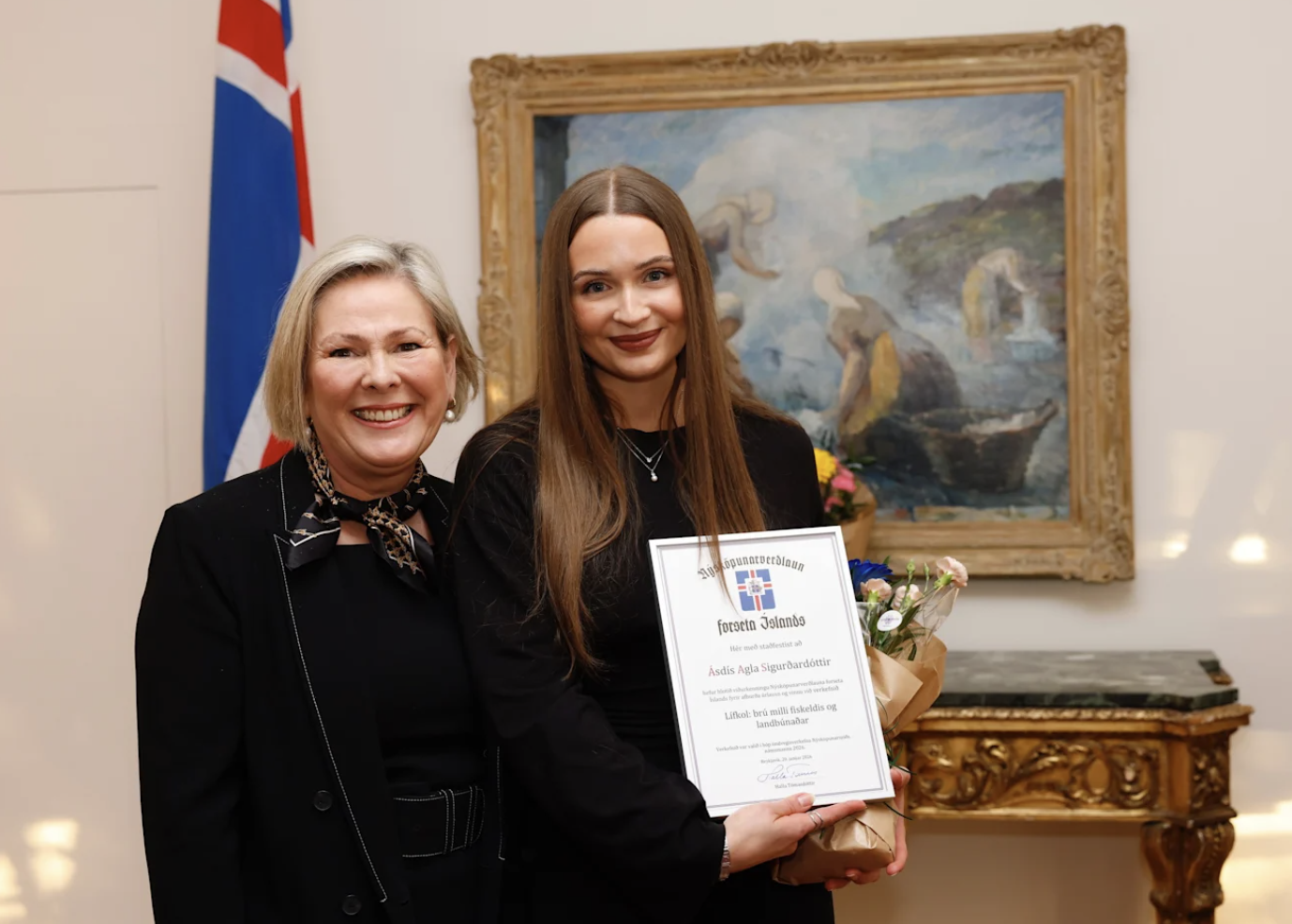
Ásdís Agla Sigurðardóttir, a food science student at the University of Iceland, received a nomination for the Presidential Innovation Award of Iceland for her project Biochar: A Bridge Between Aquaculture and Agriculture. The project was also recognised as an outstanding project.
The awards were presented at a formal ceremony at Bessastaðir on Tuesday 20 January, where the President of Iceland, Halla Tómasdóttir, presented the awards. The awards are given to students who have produced outstanding work in projects funded by the Student Innovation Fund in 2025.
The project is part of the Food Fund project Soil-Improving Organic Matter. Ásdís Agla's supervisors were Jónas Baldursson and Katrín Hulda Gunnarsdóttir at Matís. We congratulate Ásdís on a job well done.
Further information on the project:
Biochar: A Bridge Between Aquaculture and Agriculture
Land-based salmon farming is growing rapidly in Iceland, generating increasing volumes of aquaculture sludge. At the same time, Icelandic agriculture is largely dependent on imported synthetic fertilisers. Technical solutions for utilising aquaculture sludge are lacking, and it is currently disposed of in most cases despite its high nutrient content. The project focuses on utilising this by-product through biochar production and evaluating whether biochar derived from aquaculture sludge can be used as a soil amendment. Through biochar production, the sludge is converted into a stable, carbon-rich material that can improve soil properties and fertility, creating a new pathway for an underutilised raw material.
A six-week pot experiment was conducted in which treatment groups with varying ratios of biochar derived from saltwater and freshwater aquaculture sludge were compared, alongside wood biochar. The aim of the experiment was to evaluate the effects of aquaculture sludge biochar on plant growth and soil properties, and to compare the results with wood biochar. Measurements included soil pH and moisture content, plant growth and yield, and the chemical composition of the raw materials.
Results showed that biochar derived from freshwater aquaculture sludge and wood biochar had positive effects on plant growth, while biochar derived from saltwater aquaculture sludge led to crop losses and reduced yield, attributed to high salt content. Heavy metals and salt were detected in some of the biochars but did not transfer to the edible parts of the plants. Overall findings suggest that the origin and chemical composition of biochar influence its utility, and that biochar derived from freshwater aquaculture sludge may be a viable option as a soil amendment, though further research is needed to assess long-term effects and feasibility.