

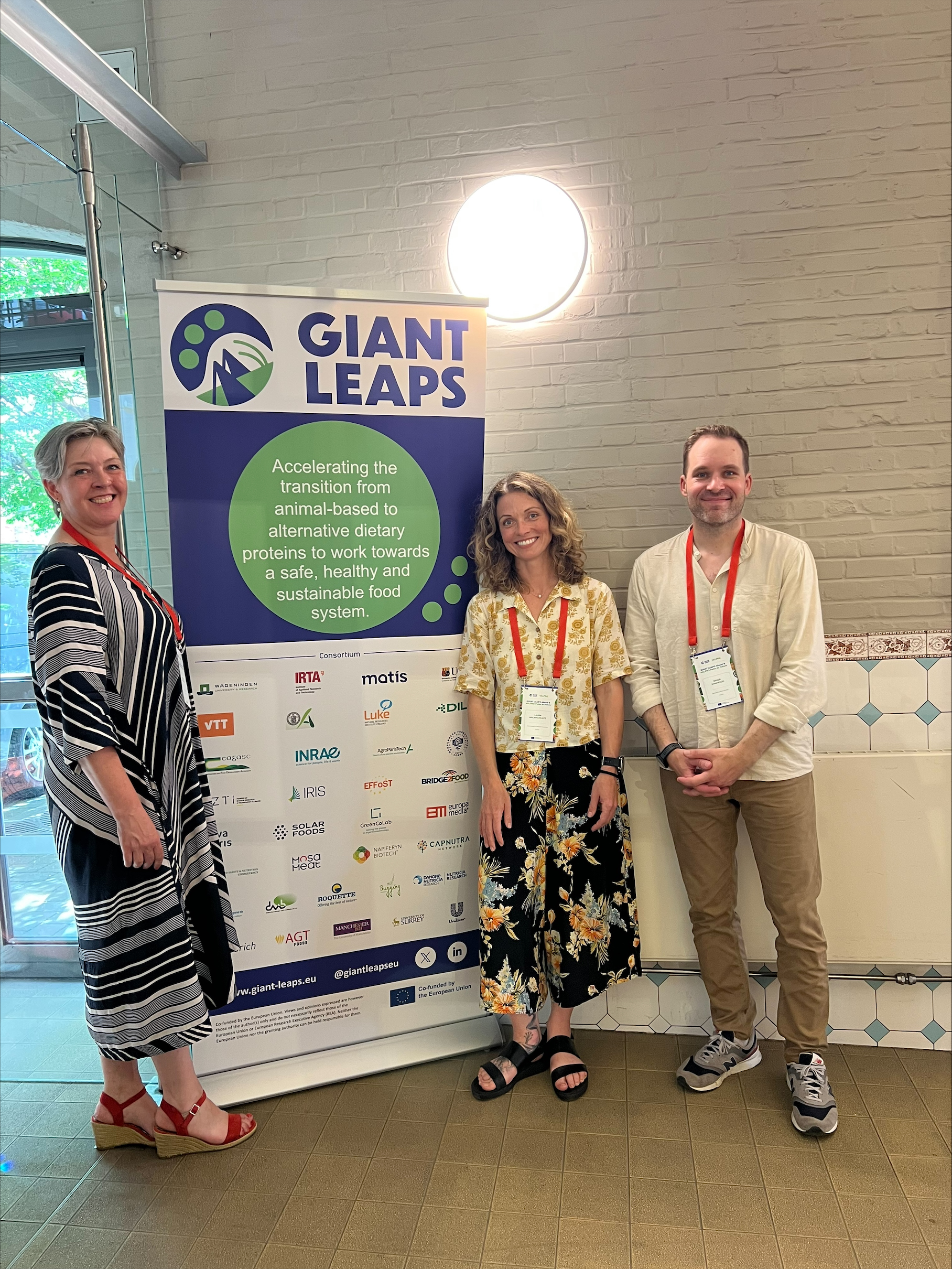
On 25 June, the GIANT LEAPS project held its final conference in Brussels, marking the conclusion of a four-year research project within Horizon Europe. The aim of the project was to advance knowledge and remove the key barriers to Europe's transition towards more sustainable protein sources. The conference, held in Brussels in collaboration with the VALPRO Path project, brought together approximately 200 researchers, industry representatives and policymakers.
Three Matís employees attended the conference: Birgir Örn Smárason, Margrét Geirsdóttir and Laura Malinauskaite.
Birgir gave a talk about sustainability which was called „What does it take to know if an Alternative Protein is Sustainable? Lessons from Four Years of Integrated Assessment“. The presentation summarised the work led by Matís within the project on integrated sustainability assessment of the production and use of novel proteins. Matís and its partners developed a methodology encompassing environmental, economic and social impacts, along with analysis of climate resilience, biodiversity and circularity.
Margrét delivered a presentation on processing and production, in which she discussed the sensory and functional challenges of novel proteins: „Exploring Solutions to Sensory and Functional Challenges in Alternative Proteins.“
Matís led work package 5, Sustainability and climate, throughout the project. Sustainability impacts were assessed for the production and use of faba beans, lentils, oats, quinoa, rapeseed, crickets, microalgae, bacterial protein and cultivated meat. One of the key findings was that no single protein source excels across all dimensions: each has its own advantages and drawbacks, and environmental benefits are not guaranteed. The degree of processing, energy use and circularity assumptions all influence the final outcome. The project ran from September 2022 to August 2026 with 34 partners from 20 countries. This is one of the most comprehensive sustainability assessments of novel proteins carried out to date, and several scientific articles on the subject have already been published, with more forthcoming.